

For a family arriving at an Australian airport, what to expect from a private transfer service is a pre-booked vehicle and driver dedicated to your group, with pickup and drop-off arranged around your journey. You can request child restraints in advance and ask for a quote based on your trip details. The key considerations are a suitable vehicle, clear pickup instructions and restraints that meet your children’s needs.
Travelling with children means coordinating more than luggage and flight times. You want to leave the terminal knowing where to meet your driver and that the vehicle is planned around your family’s needs.
This guide explains how private airport pickups work, how fixed fares differ from metered taxi and rideshare arrangements, and what to consider about vehicle hygiene, luggage and child restraints. You’ll come away with a clearer picture of the service and the details that can make an airport journey more settled for your family.
Key Takeaways
- A private transfer reserves the vehicle for your group, with pickup and drop-off arranged around your trip.
- Know where your driver will meet you and how your luggage, including prams or other oversized items, will fit.
- Compare fare arrangements by considering how the total is set and whether traffic or trip changes can affect it.
- For family travel, arrange suitable child restraints in advance and factor them into your pickup plans.
- Vehicle cleanliness and a professional driver can help make the airport journey feel more settled for you and your family.
How Does a Private Airport Transfer Work?
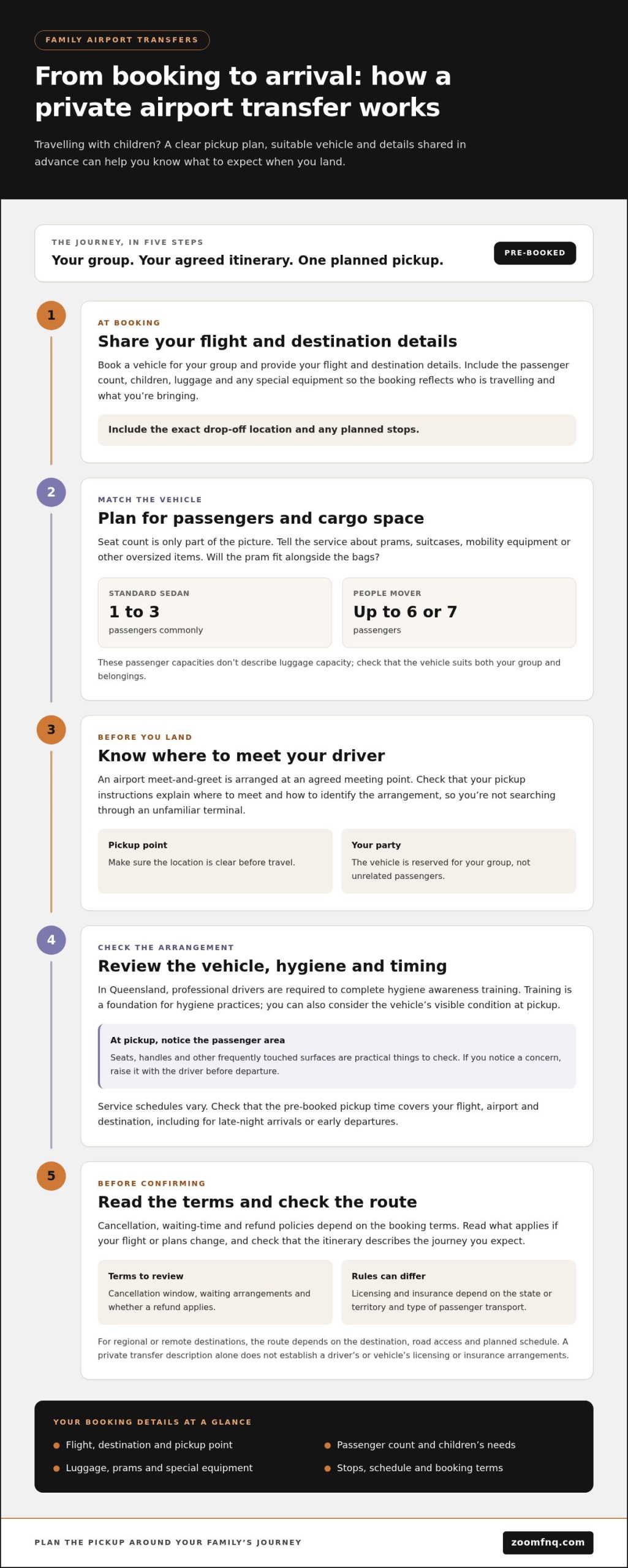
You book a vehicle for your group and provide your flight and destination details, then follow the agreed airport pickup plan. Your booking should record who is travelling, where the driver will meet you and any requirements you’ve shared.
Airport meet-and-greet and luggage assistance
An airport meet-and-greet is a pre-arranged welcome at an agreed meeting point. Your pickup instructions should say where to meet and how to identify the arrangement. Clear directions help you get from arrivals to the vehicle without searching through unfamiliar airport spaces.
Tell the service about your luggage, including prams, mobility equipment or oversized items. A family with a folded pram and several suitcases, for example, needs space for both passengers and belongings. Sharing these details helps plan for what you’re bringing, not just the number of travellers.
Private, non-shared airport journeys
A private transfer reserves the vehicle for your party rather than sharing the journey with unrelated passengers. The driver follows the agreed itinerary, which may make the trip more direct than a shared shuttle with several drop-offs. This can suit families who want to keep children, bags and travel equipment together.
Cancellation, waiting-time and refund policies depend on the booking terms. Read them to understand any cancellation window, how waiting is handled and whether a refund applies. Review these terms alongside the pickup details so you know what applies if your flight or plans change.
Driver and vehicle licensing and insurance
Licensing and insurance requirements depend on the state or territory and the type of passenger transport. There isn’t one nationwide rule covering every private transfer driver and vehicle. The phrase “private transfer” alone doesn’t establish the licensing status or insurance arrangements for a particular journey.
These requirements are separate from practical booking details such as the pickup point and vehicle type. The applicable state or territory rules and transport category determine which requirements apply. This matters when comparing transfers across Australia, as arrangements can differ between jurisdictions and types of transport.
Included services and regional availability
A booking typically sets out the pickup, destination and agreed journey. It may also include meeting arrangements or luggage assistance. Read the itinerary as a description of your trip rather than assuming every service includes the same extras. A direct journey and one with an additional stop, for example, need different route details.
In regional and remote areas, the route depends on the destination, road access and planned schedule. A journey beyond a major centre may need more planning than a short trip from an airport to nearby accommodation. Share the exact drop-off location and any stops when booking, so the itinerary reflects your destination and route.
Driver hygiene training and vehicle sanitisation
A clean vehicle and a driver trained in hygiene awareness can make a practical difference after a long flight. In Queensland, professional drivers are required to complete hygiene awareness training. When arranging an airport pickup, also consider the vehicle’s passenger and luggage space and whether its schedule suits your arrival.
Training provides a foundation for hygiene practices, while sanitisation concerns the condition of the passenger area. You can consider visible cleanliness at pickup, including seats, handles and other frequently touched surfaces. A family travelling with young children may also need room for prams and luggage, so both a tidy cabin and suitable cargo space matter.
Cleaning happens between journeys, so the condition of the vehicle at pickup is relevant to your experience. Look for clear information about cleaning practices and a vehicle prepared for passenger travel. If you notice a concern before departure, raise it with the driver promptly. A direct conversation at the start of the trip gives you a chance to address the issue before settling in.
Passenger numbers help determine which vehicle type fits your journey. Standard sedans commonly suit 1 to 3 passengers, while people movers can accommodate up to 6 or 7 passengers. A family with a pram, several suitcases or oversized luggage should account for cargo space, not just seats. Vehicle class and luggage capacity affect which option is practical for your group and budget.
Service schedules vary, so arrange a pickup that matches your flight time. For late-night arrivals or early departures, check that your pre-booked transfer covers the planned pickup time, airport and destination. This helps ensure the arrangement fits your itinerary.
Pre-booking identifies the vehicle and pickup arrangement for your party. A dedicated vehicle means your group doesn’t share the cabin with unrelated passengers. Include the passenger count, luggage, children and any special equipment in the booking details. A family with a pram, for example, needs different cargo space from three passengers travelling with carry-on bags.
Before booking a private transfer, review the hygiene information, vehicle type, schedule and booking terms. Match the vehicle to your passenger and luggage needs, then make sure the pickup time fits your flight. These details help you decide whether the arrangement suits your trip, beyond the general service description.
For a Cairns airport journey, include your passenger count and luggage needs in the airport transfer booking details.
Fixed fares compared with taxis and rideshares
A pre-arranged transfer and an on-demand trip differ in how the journey is organised. Your choice affects how clearly the pickup, route and service conditions are set before travel. Consider what matters most: a known itinerary, flexibility during the trip or access to a vehicle through an app or taxi rank.
A defined journey and inclusions
A pre-arranged journey is based on the trip details agreed at booking, such as the pickup point, destination and planned route. This gives you a clear reference for the scheduled service. If you need an extra stop or a different destination, the original arrangement may no longer match your journey.
A taxi journey is handled through the taxi service, while a rideshare trip is organised through its platform. Each option has its own process for pickup changes, route adjustments and driver communication. Before travelling, consider whether your group needs a set plan or flexibility. A family with a tight connection, for example, may value having pickup instructions in advance.
Upfront journey information
Upfront information sets expectations before you confirm a trip. Review the pickup location, destination, stops, vehicle requirements and any conditions affecting changes. These details clarify what the booking covers and what may need separate arrangements. A clear itinerary is especially useful when several people are joining at different points.
With an app-based rideshare, you enter trip details through the platform and follow its processes. A taxi is typically arranged at a rank or by booking, with the route determined during the journey. A pre-arranged transfer lets you review the itinerary before departure. The most useful format depends on how much structure your plans need.
Traffic can affect a road journey’s duration and route, even if the pickup and destination stay the same. For a metered taxi, a longer trip through congestion can affect the fare. A pre-arranged journey begins with agreed trip details, although road conditions still affect travel time. Rideshare platforms may also handle route changes according to their own processes.
A shared shuttle works differently, as unrelated passengers may travel together and make several stops. Public transport follows published routes and timetables, which may mean extra connections between an airport and your accommodation. Compare each option with your luggage, schedule and preference about sharing the journey. Choose what suits your actual trip, not just the general service description.
Child restraints and family travel
For a family, planning child restraints is part of the travel routine, not just another item on the packing list. An infant may need a baby capsule, while an older child may use a suitable child car seat or booster. Explain each child’s needs so that restraints aren’t treated as interchangeable. Also consider who will sit beside each child during the ride.
Plan for the whole transition from airport to accommodation. After collecting bags, one adult may need to keep a toddler close while another manages a baby and carry-on items. A private journey can keep your family together, but boarding still takes a little coordination. Decide who will carry each bag, help each child and keep essentials within reach once everyone is seated.
Children may be tired, hungry or unsettled after a flight. A familiar toy, drink or comfort item can help them settle while the driver prepares to depart. Keep these essentials accessible rather than packed beneath larger luggage. For example, put a child’s water bottle in a small day bag so you don’t need to unpack suitcases at pickup.
Consider the seating arrangement as well as the restraint. If an adult needs to sit beside a younger child, agree with the other travellers how to arrange the cabin. Families with siblings may want each child seated where an adult can help. Clear expectations make it easier to settle in without rearranging everyone after departure.
A longer drive may call for a different routine from a short trip to nearby accommodation. A child who falls asleep after take-off may need a quiet transition from terminal to vehicle, while an awake toddler may need a snack for the road. Plan what your family needs and keep relevant items easy to reach. Stow loose belongings so they don’t obstruct seats or access.
Restraints need to suit the children travelling that day. If relatives or friends join the trip, the passenger list may differ from your usual family arrangement. Tell the booking service which children need restraints and whether their needs have changed. A clear description is more useful than simply saying, “We’re travelling with kids.”
The National Transport Commission’s review of Australian child restraint exemptions for taxis and rideshares is expected to produce findings in late 2026. For your own family journey, focus on the planned restraint arrangement and the children travelling. A little coordination before leaving the terminal can help everyone settle into the ride with less last-minute disruption.
What is included in a private transfer service in Australia?
A private transfer booking sets out a dedicated vehicle, pickup point and destination for your party. The itinerary may also record flight details, passenger numbers, luggage and planned stops. These details shape the service, so compare the booking terms with your actual journey rather than assuming every transfer has identical arrangements.
For an airport pickup, the plan can include a driver meeting you at an agreed location. At Brisbane Airport, international passengers can meet a chauffeur after clearing customs, while domestic passengers can meet after collecting their luggage. Check that the instructions explain the meeting point and how to identify your driver. Clear directions matter when you arrive with children or several bags.
Vehicle choice is another part of the booking. Providers commonly offer standard sedans for 1 to 3 passengers and people movers for up to 6 or 7 passengers. The right fit also depends on cargo space: a family travelling with suitcases and a pram needs to account for luggage, not only seats. State passenger numbers and oversized luggage when arranging the trip.
A private transfer itinerary can follow the agreed route and stops. For example, a Brisbane Airport journey can be planned to include five stops to collect passengers along the way. That differs from a direct door-to-door service, which takes your group from its pickup point to the booked destination without intermediate stops. List each stop clearly so the driver’s route matches your plans.
Flight details help shape the pickup schedule. If an incoming flight arrives early or late, the driver’s arrival time may be adjusted when the service includes flight delay handling. At Brisbane Airport, the meeting point also differs for domestic and international arrivals. Keep the flight number and terminal details accurate in your booking to support a coordinated pickup.
Some arrangements include luggage assistance or child restraints when requested as part of the booking. Treat these as trip requirements, not assumptions: record the restraint type, number of bags and any oversized items. A booking with a baby capsule, pram and several suitcases needs a different vehicle setup from one for a solo traveller with carry-on luggage.
Operating hours and after-hours terms can also affect what the booking covers. Some private transfer providers charge after-hours surcharges for bookings between 8 PM and 6 AM. Review the applicable terms alongside your pickup time, especially for an early flight or late arrival. This helps you understand the complete arrangement before confirming.
For your Cairns journey, set out the pickup, destination, passenger count and luggage requirements in the airport transfer booking. A precise itinerary gives the driver a practical plan and helps match the vehicle to your trip.
Zoom FNQ: Cairns Airport Transfers
Zoom FNQ provides professional airport transfers for families who want a pre-booked journey from the terminal to their accommodation. Its reliable chauffeurs and private service offer a practical option when you’re travelling with children, luggage or both. Request child restraints, including baby capsules and child car seats, when booking to plan **what to expect from a private transfer service** around your family’s needs.
From the airport, arrange a seamless transfer to your chosen hotel, resort or holiday destination. Share your location, passenger numbers, luggage and restraint requirements when booking, so the journey details reflect your plans. To organise a family airport pickup nationally across Australia, contact Zoom FNQ during its office hours.
Plan an easier arrival for your family
Knowing what to expect from a private transfer service helps you plan the details that shape your arrival. Think beyond the flight: decide how your family wants to begin the stay, what should be close at hand and how you’d like the journey from the airport to feel. A clear plan can make the transition from terminal to accommodation calmer for everyone.
Zoom FNQ offers Cairns Airport Transfers, local city connections and Palm Cove transfers. Choose the destination that fits your itinerary, then include your travel details and family’s needs when arranging the trip. A considered pickup plan gives you a useful starting point for the next stage of your holiday.
When you’re ready to organise your journey, contact Zoom FNQ to plan your transfer. Your family’s next Cairns arrival can start with a plan that feels clear and welcoming.
Frequently Asked Questions
How does a private transfer differ from a taxi, rideshare, shuttle, or public transport?
A private transfer is arranged for your party and itinerary, rather than through a taxi rank queue, app dispatch or public transport timetable. Knowing what to expect from a private transfer service starts with understanding that your group has a dedicated booking, while a shuttle may carry other travellers and make additional stops. If you’re arriving with several bags, compare how each option handles your route and final address.
How much does a private transfer cost in Australia, and what affects the price?
The fare depends on your trip details and is provided after you request a quote. Factors include distance, pickup and destination, vehicle type, passenger numbers, luggage, requested child restraints and extra stops. A group with bulky bags, for instance, may need a different vehicle from a couple travelling light. Compare the quoted itinerary and inclusions, not just the vehicle type.
How do I book a private transfer and confirm pickup details?
Book in advance and provide the travel date, flight information, passenger count, destination and any special requirements. To understand what to expect from a private transfer service on arrival, check that the confirmation’s names, terminal, pickup time and drop-off address match your plans. If your itinerary changes, update the booking through the contact details provided. For a family, include prams and child restraint needs.
What should I expect at airport pickup, including meeting points and flight tracking?
Your booking confirmation should explain where to meet and how the pickup is arranged. Airport layouts may separate pickup zones from arrivals, so check the terminal and meeting instructions before leaving the baggage area. Flight tracking is offered by some transfer services, but isn’t automatic with every booking. Keep your flight details and confirmation accessible if your arrival information changes.
Are child seats, luggage, accessibility, and extra stops included or available?
Vehicle and booking arrangements shape what can be accommodated, so state each requirement when booking. Give the number and type of child restraints needed, describe oversized luggage and include any mobility or access needs. A standard vehicle description doesn’t establish accessibility features. List extra stops in the itinerary too, as they can affect the route and fare. Clear details help align the transfer with your group’s needs.
What can go wrong during a private transfer, and what should I do if my driver is late?
Traffic, a changed flight arrival or uncertainty about the pickup zone can disrupt a transfer. If your driver hasn’t arrived at the stated meeting point, first check your confirmation for the correct terminal and pickup instructions. Then use the contact method in your booking, sharing your name, location and flight details. Wait in a safe, clearly identified area while resolving the pickup.
Related posts



Leave a Comment